Most businesses do not get a warning before their accounting software stops keeping up. The signals show up in the workarounds instead — in the spreadsheets, the delays, and the manual re-entry.
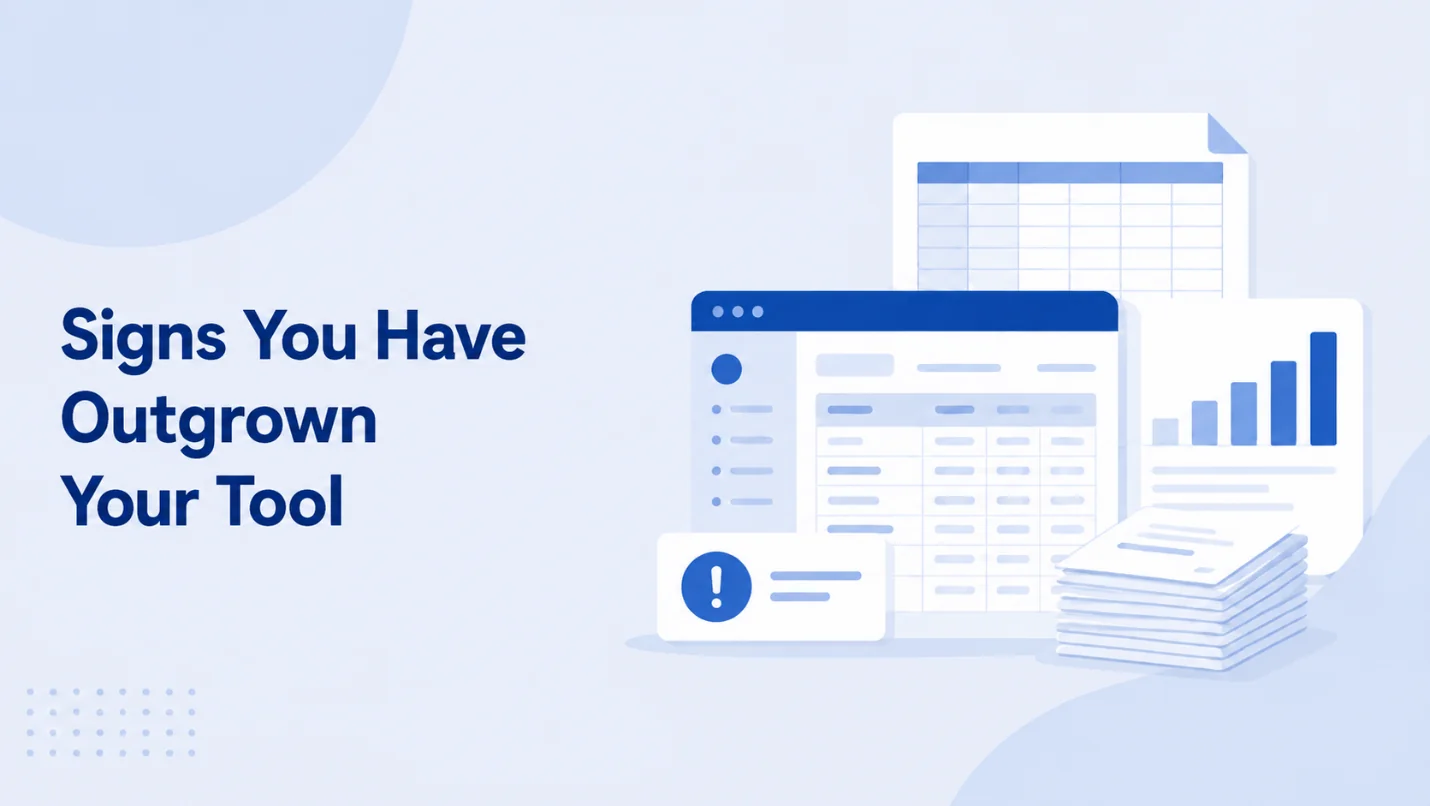
Rekeying between systems
The same figures are entered twice to make two tools agree.
Reports arrive days late
Numbers are already out of date by the time they are read.
Journals that will not bend
Fixed transaction formats no longer match how the business runs.
The tool did not change, the business did
Entry-level accounting tools are built to be cheap, quick to set up, and simple to run, and they do that well for a business in its first years. What shifts is the volume, the number of entities, and the number of questions the accounts are expected to answer.
The symptoms show up as workarounds
Outgrowing a system rarely announces itself as a failure. It appears as a spreadsheet that sits beside the software, a monthly export that someone reformats by hand, or a close that now takes a week instead of an afternoon.
Each workaround is small on its own. Together they become an unpaid process that the business maintains every month.
When a business spends more time moving data between systems than reading what the data says, the ledger structure is the constraint — not the effort.
Why ledger structure is usually the root
Most of these symptoms trace back to how the underlying ledger is organised. When payables, receivables, and the general ledger are held separately, keeping them aligned becomes manual work that grows with transaction volume.
What AOC does differently
AOC Accounting wraps AP, AR, and GL into a combined ledger, with a chart of accounts that prevents double entries. Journal types are defined by the business rather than fixed by the vendor, and reports are available immediately without a separate export step.
Reading the signal in time
These signs are a growth marker, not a mistake. Acting on them while the ledger is still small keeps migration straightforward; the same move made two years later carries far more history across.
Features and benefits
The features below all describe AOC Accounting and what each one gives a business that is outgrowing its current tool.
| Feature | What it means for you |
|---|---|
| Combined ledger | AP, AR and GL sit in one place, so there is nothing to reconcile between separate systems. |
| Chart of accounts controls | Structural prevention of double entries, rather than catching them after the fact. |
| User-defined journal types | Transaction sequences, document printing and auto-reversal are configured to match how the business actually operates. |
| Reports available immediately | Reports are available as transactions are posted, with no export or rebuild step. |
| Up to 10 analysis dimensions per function | Results can be viewed by department, project, location or any other cut. |
See whether your tool has been outgrown
A short demo walks through how a combined ledger, user-defined journal types and immediate reporting absorb the volume and complexity your current setup works around.