

Tag: Journal Types

  • What User-Defined Journal Types Let a Business Do

    What User-Defined Journal Types Let a Business Do

    User-defined journal types let a business close books faster, maintain a written approval trail for every posting, cut repetitive Excel typing, and produce management accounts that actually help decision-making and performance evaluation. If your finance team still chases approvals by email and rebuilds reports by hand each month, journal types are the structural fix.

    1. What Is a User-Defined Journal Type in Modern Accounting Software?

    In personal life, different types of journals serve unique personal and organizational purposes. Gratitude journals focus on listing things one is thankful for each day, dream journals are kept to record dreams upon waking, health journals track physical metrics and fitness routines, and bullet journals use rapid logging to organize tasks and goals. Different journaling formats cater to various emotional needs and preferences; keeping a journal can improve mental clarity, and regular journaling can track personal growth over time. Writing helps improve memory and cognitive processing, writing can help clarify thoughts and enhance problem-solving skills, and journaling can reduce stress and process emotions. While the act of handwriting can engage the brain more actively than typing, even digital journaling delivers benefits-emotional release through writing can lower anxiety, and keeping a journal can act as a safe space for externalizing feelings. Starting a journaling habit should focus on consistency over length, and using prompts can help when a writer is unsure what to write.

    In accounting, the same principle applies: different kinds of journal serve different control needs. A journal type in modern software is a reusable template controlling the number sequence, default accounts, required fields, approval rules, and automatic reversal behaviour for a group of similar transactions. Legacy systems offer fixed types-“JV”, “PV”, “RV” locked by the vendor with rigid behaviour. Modern cloud systems like AOC Accounting let finance teams configure their own. When you evaluate software based on your business’s growth stage, look for user-defined journal types that support multi-currency transactions, instant reporting capabilities, and integrated accounting functions.

    Concretely, a controller can configure posting date rules, currency handling, mandatory analysis dimensions up to 10 analysis dimensions can be defined per function, covering department, project, cost centre, brand, and more along with document attachment requirements and access rights for who can post or approve. Multi-currency features enable transactions in different currencies. Multi-entity accounting supports multiple business entities in one system and allows for consolidated financial reporting across entities. Journal types can have user-defined numbering sequences, source documents can be attached to every journal entry, and multi-level journal approval processes keep sensitive postings under control. The result: less manual typing of GL codes, narration text, and tax codes on every screen, because recurring details are pre-filled.

    2. Operational Control: Standardising How Transactions Are Posted

    User-defined journal types give the finance manager precise control over how each kind of transaction enters the ledger. You might define types for “Monthly Accruals Operating Expenses”, “Prepayments Insurance & Rent”, “Payroll – Salaries & CPF”, or “Intercompany SG to MY”. Each type can lock posting to specific GL ranges, require certain analysis dimensions, and block posting to prior locked periods. The person preparing an accrual journal only fills in variable fields-amount, period, counterparty-while account codes, narration, and cost centres are inherited.

    Month-end close typically occurs on the last day of the month, and the process ensures all financial transactions are recorded accurately. It often involves reconciling accounts and reviewing journal entries, and it helps prepare financial statements for reporting. A concrete way to hit close targets: schedule all “Accrual” journal types to be prepared by day +3, reviewed by day +4, posted by day +5, with status tracking on screen inside AOC Accounting instead of spreadsheet trackers. Industry benchmarks put median consolidated close at about 6.4 days; well-controlled SMEs in Singapore increasingly aim for five.

    Illustration of a finance team tracking accrual journals through prepare, review and post stages at month-end

    3. Governance, Approvals and Audit Readiness

    Auditors in Singapore and the wider region now expect clear journal approval trails. IRAS audit guidelines emphasise proper supporting documents and accurate classification. GST compliance is mandatory for businesses in Singapore; GST registration is required for businesses earning over S$1 million, businesses must submit GST returns quarterly or annually, InvoiceNow is part of Singapore’s e-invoicing framework, and non compliance can result in penalties and fines. Corporate tax filing includes submitting Form C-S in Singapore, companies must file Estimated Chargeable Income (ECI) within three months, the corporate tax rate in Singapore is 17% on chargeable income, and filing deadlines vary based on the company’s financial year end whether it ends in Oct, Mar, or Dec.

    In AOC Accounting, each journal type can have its own approval workflow: a routine accrual may need one supervisor, while a “Management Adjustment” type requires finance manager and CFO sign off. Attachment rules by type-say, “Supplier Accrual Freight” requires a PDF of the freight statement-block posting if documents are missing, keeping the ledger audit ready. An auditor can filter the ledger for “Non-Standard Journal” types and immediately see who prepared, who approved, timestamps, and attached documents. Audit readiness requires organized financial records, regular internal audits improve audit readiness, document retention policies support it, staff training enhances understanding of audit processes, and audit readiness involves timely financial reporting. Separating sensitive types like “FX Revaluation” or “Topside Adjustments” with stricter approval chains and login level access controls prevents unauthorised postings and improves segregation of duties. Bank reconciliation ensures accurate financial records, identifies discrepancies between bank statements and accounting records, helps prevent fraud and errors, is typically performed monthly or quarterly, and involves comparing transactions in both records.

    4. Reporting and Analysis: Turning Journal Types into Management Insight

    When every posting carries a meaningful journal type plus analysis dimensions, the finance team can slice reports in a way that goes beyond account codes and dates. In AOC Accounting, the monthly P&L can separate “Operational Accruals” from “Late Adjustments,” and a dashboard can track the volume and value of manual journal activity over time as a control metric. It offers instant reports exportable to PDF or Excel.

    Accounts receivable represents money owed by customers, effective accounts receivable management improves cash flow, chasing unpaid invoices can reduce outstanding accounts receivable, a 30 day collection period is common, and automating invoice reminders can enhance collection efficiency. CFOs found that filtering by journal type makes it easier to compare recurring versus one off items, improving the quality of board packs. Consolidation merges financial reports from multiple entities and is essential for accurate financial reporting; AOC Accounting offers multi-currency and multi-entity consolidation, so group finance can bring consistent analysis across Singapore, Malaysia, and Indonesia entities. Scalable accounting systems can handle multiple entities and currencies, support up to 10 analysis dimensions per function, allow for instant reports upon journal posting, and enable flexible user-defined journal types these systems are designed for growing small and medium businesses. AI-driven industry trends in 2026 demand real time visibility; a browser based unified ledger removes the need to export into Excel and reclassify entries by hand, helping management learn what happened in time to act on it.

    Illustration of a management report filtered by journal type and analysis dimensions

    5. Designing Journal Types in AOC Accounting: Practical Patterns to Copy

    From AOC Accounting’s advisory experience with SMEs since 2015, here is a starter set of types to support your goals:

    • Revenue adjustments and cost of sales allocations
    • Operating expense accruals and prepayments (insurance, rent)
    • Payroll and staff costs (salaries, CPF, EPF)
    • Tax and statutory provisions (GST, ECI, Form C-S)
    • Intercompany and consolidation adjustments
    • FX revaluations and management topside entries

    Use naming conventions like ACCR-2026-0001 for accruals so every number aids quick searching and audit queries. Involve both operations and finance when designing types if required dimensions do not match how the business actually measures performance across departments, projects, or brands, the data becomes noise.

    AOC Accounting’s team can help by reviewing existing journal posting activity, mapping entries into a cleaner journal-type structure, configuring approvals, and training staff to reduce manual work and spreadsheet dependence. Combined ledgers integrate Accounts Payable, Receivable, and General Ledger into one book no reconciliation between modules, no UK or US style modular lag.

    Ready to see it in action?

    Request a Demo of AOC Accounting to see user-defined journal types, unified ledger posting, and instant reporting on live data so your next month end close hits its targets, not your team’s patience.

    Request a Demo

    Journal TypesAccruals and ReversalsCombined LedgerAnalysis DimensionsAccounting Software Features
  • What Actually Makes an Accounting System Scalable

    What Actually Makes an Accounting System Scalable

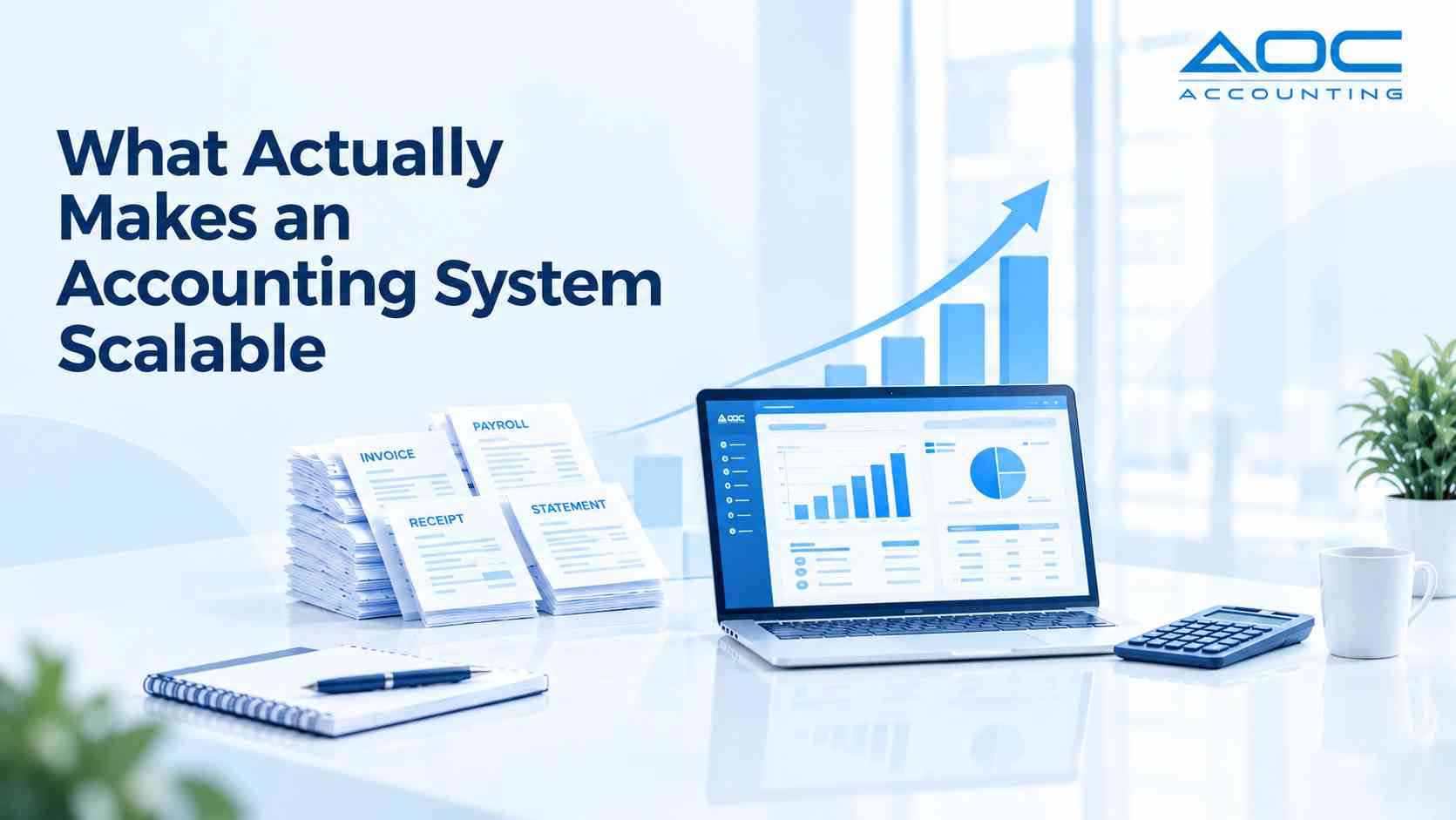
    A scalable accounting system is one that keeps working, without workarounds outside it, as your business adds transactions, entities, currencies and people. This article breaks down what actually makes an accounting system scalable, so you can plan for the next three to five years of growth.

    Why Scalability Matters in 2026 and Beyond

    An accounting system is more than a piece of software. It is the combination of people, processes, tools and data structure that records and reports every financial transaction in your organisation, and it is how management sees the real financial health of the business.

    For a Singapore business growing from S$200,000 to S$5 million in annual revenue over three to five years, scalability is not optional. Growth brings more transactions, more currencies, more entities and more regulatory obligations. Without a system designed for that trajectory, the cracks appear fast.

    Common signs that an accounting system is not scaling:

    • Month-end closing drags into two or three weeks because data lives in disconnected spreadsheets and files
    • Spreadsheets introduce mismatched currencies, missing invoices and broken formulas
    • Tax treatment is inconsistent across entities, creating compliance risk with IRAS and regional authorities
    • Management decisions wait on financial information that arrives too late
    • Internal controls are weak because one person handles everything with no audit trail

    The common thread is that the finance team starts doing outside the system what the system was bought to do inside it. That work, the export, the spreadsheet, the manual reconciliation, is the real signal, and it appears long before any software capacity limit is reached.

    Core Principles of a Scalable Accounting System

    Scalability in accounting means your system can handle more transactions, more entities and more complexity without losing accuracy or control. It is not about buying the most expensive software; it is about building the right foundation.

    • A standardised accounting process with clear controls, audit trails and role-based access, rather than “everyone edits everything”
    • Double-entry bookkeeping, where every transaction affects at least two accounts; single-entry records are only workable for the very smallest businesses
    • Accrual accounting, which records income when earned and expenses when incurred, giving a truer picture of your financial position than cash accounting as the business grows
    • Documented, process-driven workflows instead of knowledge that lives in one bookkeeper’s head
    • A structure that can absorb expansion into Malaysia, Indonesia or Vietnam, where local tax rules differ and related-party transactions between your entities need to follow transfer pricing rules

    1. Data Architecture: From Single Ledger to Multi-Entity, Multi-Currency

    The underlying data structure of your accounting system is the first pillar of scalability. Get this wrong and every report, consolidation and audit becomes a fight.

    • Ledger design. In module-based systems, accounts payable, accounts receivable and the general ledger are separate subsystems. That works while transactions are simple, but intercompany charges, part-payments and credit notes across several invoices end up recorded in more than one module, and period-end includes a reconciliation between them that grows with the complexity of the books, not just their volume.
    • Chart of accounts. A scalable chart of accounts uses consistent numbering with enough structure to track entities, regions, cost centres and departments, yet stays lean enough to maintain.
    • Multiple entities. Each legal entity needs its own ledger, with group-level consolidation for a Singapore holding company with regional subsidiaries.
    • Multiple currencies. Foreign currency transactions need consistent exchange rates, FX revaluation and a clear split between realised and unrealised gains, and for GST purposes amounts must be converted to Singapore dollars using an approved exchange rate.
    • Migration. When you move from a legacy system, data migration determines whether your opening position is reliable. Back up everything before major changes and agree the account structure before any data moves.

    2. Process Design: Making the Accounting Process Repeatable and Reliable

    Scalable systems rely on documented, repeatable processes rather than tribal knowledge. When the finance function depends on one bookkeeper who “just knows how things work,” you have a fragility problem, not a system.

    • Processes that must scale include invoicing, expense claims, bank reconciliation, month-end closing, GST filing, budgeting and year-end audit preparation
    • Checklists and standard operating procedures let a growing team follow the same steps across entities and branches, which is often the difference between a five-day close and a three-week close
    • Automation such as approval flows for bills, payment reminders and digital expense claims removes repetitive manual work and frees the team for analysis
    • The system should adapt to your processes, not force you to work around it. In many systems, journal types (the rules for how a class of transaction is numbered, documented and reversed) are fixed by the vendor, so a new numbering scheme for a new entity or an automatic reversal for a class of accrual means either a manual workaround or paid customisation

    3. Technology Stack: Choosing Accounting Software That Can Grow With You

    The core accounting software is the engine of a scalable system, supported by tools for expenses, payroll, e-commerce, POS and CRM. Choosing well at the start matters, because re-platforming later costs money, time and morale.

    • Cloud accounting software gives access from anywhere, which is essential for teams spread across Singapore and Southeast Asia
    • Look for multi-currency handling, multi-entity reporting, granular user permissions, local tax support and the ability to exchange data with other systems
    • The software that suits a micro business today may not suit a regional group in 2028, so evaluate against where you expect to be, not only where you are
    • Ask how the system handles complexity, not just volume. Entry-level tools are inexpensive and quick to start, but their ledger and reporting were built for simple books. Enterprise systems handle complexity, often at the cost of consultants and long implementation projects
    • Good software reduces human error, which matters more as transaction counts climb and tolerance for mistakes shrinks

    Accounting software and connected business tools supporting a growing company

    4. Integration Capability: Accounting Software and Other Software Working Together

    True scalability depends on how well your accounting system exchanges data with other software, not only on the features inside the ledger.

    • Typical connections for Singapore and regional businesses include bank payment files and statements from banks such as DBS, OCBC and UOB, payroll and HR systems, e-commerce platforms and payment gateways
    • Integration reduces manual entry, cuts errors, speeds up month-end close and gets reports to management sooner
    • Standard data formats and import templates let you add or switch tools without rebuilding everything from scratch
    • Every integration should be reconciled and tested, so the finance team can trust the numbers as volumes grow

    5. Performance and Volume Handling: When Transaction Counts Explode

    Transaction volume rarely grows in a straight line. A business can go from dozens of invoices a month to thousands of entries across several channels once it adds an online marketplace or launches a regional promotion.

    • Spreadsheets and basic desktop tools become unreliable at high volume: slow, prone to corruption and hard to audit
    • Features that help with volume include batch imports, recurring journals, automated bank and payment files, and automatic reading of recurring supplier invoices
    • Real-time access to financial data is only possible when the system handles volume without slowing down
    • Test thoroughly before a full transition, keep the software updated, and archive and structure older data so reports stay fast year after year

    6. Controls, Compliance, and Audit-Readiness at Scale

    As headcount and transaction volume grow, strong internal controls become more important, not less. Segregation of duties, approval hierarchies and controlled access prevent the errors and fraud that can sink a growing business.

    • Singapore companies must keep accurate records to support GST reporting, corporate income tax and annual financial statements prepared under the accounting standards set by ACRA
    • Your accounting software should provide audit trails, date-stamped entries and a link from every entry to its source document
    • Real-time access to financial data means anomalies surface sooner, before they compound into material misstatements
    • Imagine discovering a GST misstatement only during an IRAS audit because nobody reconciled foreign currency invoices at the approved exchange rate. Accurate, timely records prevent that kind of surprise
    • Consider a growing SME where one bookkeeper both creates and approves payments. That lack of segregation invites errors and worse. A scalable system enforces separation through role-based permissions and approval workflows

    7. Reporting, Consolidation, and Management Insight

    Scalability is not only about capturing data. It is about producing timely, meaningful reports as the organisation becomes more complex.

    • Reporting needs that emerge with growth include segment reporting, project profitability, entity-by-entity P&L, cash flow forecasting and consolidated financials with elimination entries
    • Operational dashboards for managers and statutory reports prepared under SFRS or IFRS serve different purposes, and the system needs to support both
    • The most common workaround in a growing finance team is the export: data leaves the system, gets reshaped in a spreadsheet and comes back as a report. It happens because the reporting layer can only cut data by one or two dimensions, such as account and period, while the business is asking for entity, department, project and cost centre at once
    • Whether a system can answer those questions directly is a structural property, not a feature toggle, and it is one of the clearest tests of scalability

    8. People and Governance: Scaling Beyond the Founder and One Bookkeeper

    A scalable accounting system assumes many users with different needs: founders, in-house finance staff, external accountants, auditors and investors.

    • User roles and permissions define who can create, approve, post and view each type of transaction. This is not bureaucracy; it is responsible design
    • Training makes new software stick. Without proper onboarding, people drift back to old habits and spreadsheets
    • Governance practices such as a monthly closing calendar, written finance policies and periodic reviews by advisers keep the system honest and current
    • Good governance lets the founder delegate while keeping financial oversight. A services firm growing from 5 to 25 staff in 18 months, for example, needs defined roles, training and a closing calendar to expand into new markets without adding senior finance hires

    9. Where AOC Accounting Fits in a Scalable Accounting System

    The ingredients of a truly scalable accounting system come down to eight dimensions: data architecture, documented processes, the right technology stack, integration, volume handling, controls and compliance, reporting, and governance. Miss one and you are building on sand.

    AOC Accounting is a combined ledger accounting system built for the structural side of that list:

    • Combined ledger. AP, AR and GL post into one ledger, and the chart of accounts prevents the same transaction being recorded twice by two routes, so there is no reconciliation between modules at period-end.
    • Flexible journal types. The business, not the vendor, defines each journal type’s transaction sequence, printed document and auto-reversal rule. When a process changes, the configuration changes with it, with no implementation partner or development ticket.
    • Analysis dimensions. Up to 10 analysis dimensions per function let you report by entity, department, project or cost centre straight from the ledger, without the export-and-rebuild step.
    • Volume tools. Import journals from an Excel template, let the Supplier Invoice Reader draft entries for recurring supplier invoices, and use eBank Payment to generate the bank file for batch payments.
    • Controls. Journal approval sets who signs off before an entry posts, and document attachment links every journal to its source.
    • Reports available immediately. Standard financial reports come straight from the ledger and export to PDF or Excel.

    The practical test before buying any system is simple. Ask the vendor what closing the books looks like when there are three entities, a shared cost centre, and a report needed by project and department at once. The answer will describe either configuration inside the system or work outside it, and that distinction is what scalability means in practice.

    This article provides general guidance on scalable accounting systems and is not professional tax or legal advice. For advice specific to your business, consult a qualified accountant or tax adviser.

    See how your close would run in AOC

    A walkthrough of the combined ledger, user-defined journal types and analysis dimensions, using your own entity and reporting structure.

    Request a Demo

    ScalabilityCombined LedgerJournal TypesManagement ReportingGrowing Businesses

Let our system handle the ledger while you focus on the business. AP, AR, and GL in one product — built by Strategic Asia since 2015.

+65 8833 0800Kenchan@aocaccounting.comSingapore · Malaysia · Thailand · Indonesia
Copyright © 2026 AOC Accounting | All right reserved.Back to top ↗