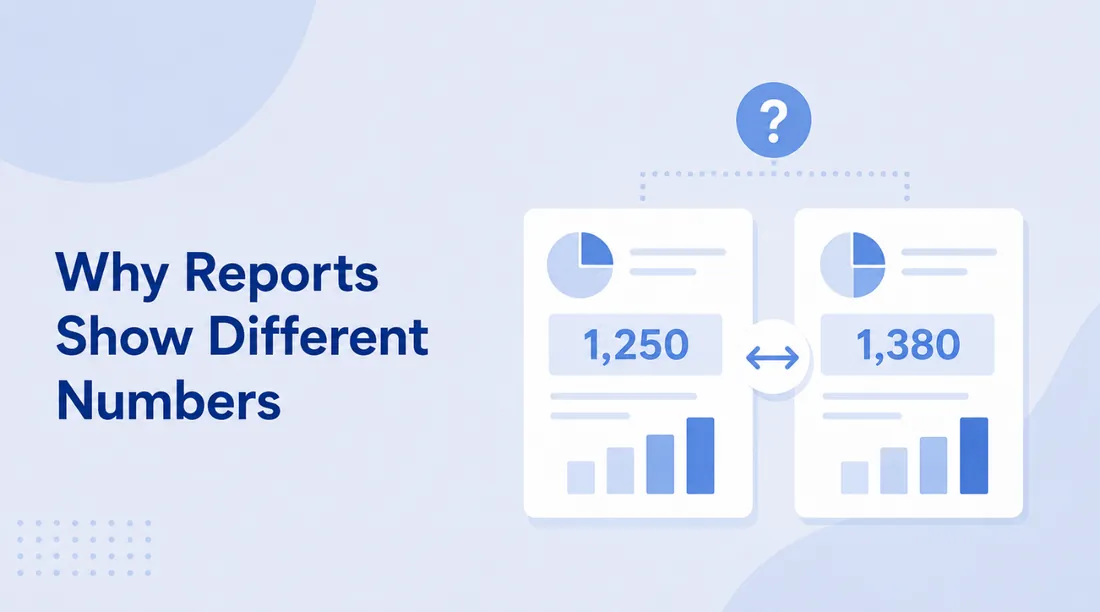
The difference is rarely a mistake in either report. It usually comes from the same figure being held in more than one place, with nothing requiring the copies to stay in agreement.
1. The same figure is recorded in more than one place
Someone asks what revenue was in July. The sales report gives one figure, the management pack gives a second, and the trial balance gives a third. Nobody has made an error. Each report read from a different record of the same month’s work.
This is what happens when receivables sit in one place, the general ledger in another, and the reporting in a workbook. Three records of one month, each updated by a separate action. They match only at the moment somebody reconciles them, and between those moments they drift apart at a rate that has little to do with how careful the team is being.
Where AP, AR and GL sit in a single ledger, the aged receivables listing and the receivables balance in the trial balance are the same records shown two ways. AOC is built this way, with the chart of accounts preventing the same transaction being recorded twice. A question about July revenue then has one place to look, and two reports agree because they read the same underlying rows rather than because someone checked.
2. An export freezes the ledger at a moment
Most management packs are built by exporting the ledger into a workbook and arranging it there. The export is accurate at the second it runs. Everything posted afterwards, including the three corrections that arrived on the Wednesday, exists in the ledger and not in the pack.
The pack goes to the board. The trial balance goes to the accountant a fortnight later. The two documents now differ by the value of those corrections, and working out why means establishing when each file was produced and what had been posted by then. Teams usually respond by declaring a hard cut-off and refusing late entries, which holds until an entry genuinely has to change.
The moment a report is exported, it stops being a view of the ledger and becomes a copy of it.
Reports drawn straight from the ledger have no copy to age. Reporting in AOC is available immediately rather than as a separate export step, so a correction posted on Wednesday shows up the next time the same report is printed, and reissuing the pack is a reprint rather than a rebuild.
3. Two structures describe the same split
A business wants revenue by service line. The accounting tool has no field for service line, so the split gets built somewhere else, normally in a spreadsheet with a mapping table that assigns each account or each customer to a category.
That mapping is a second chart of accounts, maintained by hand, usually by one person. A new service launches, a customer shifts category, an account is added. If the mapping is not updated in the same week, the departmental report and the ledger describe two different businesses, and each is internally consistent, which is why the difference can sit unnoticed for months.
AOC supports up to 10 analysis dimensions per function, so service line, project, office and customer group are captured on the transaction when it is entered. Revenue by service line and total revenue then come out of one set of records, and the split is a filter rather than a translation. Adding a new service means adding a value to a dimension instead of rewriting a lookup table and re-checking last year’s figures against it.
4. Adjustments that live in only one document
Reports also get adjusted after they leave the ledger. Someone spots that the depreciation charge is wrong and corrects it in the board pack, intending to post the journal later. A cost is reclassified between two departments in the spreadsheet because that takes a minute and a journal takes fifteen.
Each of those is defensible on the day it happens. Six months of them produces a management pack that no longer ties to the ledger at any point, and reconciling the two at year end becomes a project of its own. It also raises an awkward question in an audit, when the figure reported to the board differs from the figure in the accounts with no journal explaining the gap.
The structural answer is to make the ledger the easier place to record the adjustment. Where the business defines its own journal types rather than working from a fixed set, a recurring reclassification can be configured as its own transaction type, with its own sequence, printed document and reversal rule. Posting it properly then costs less effort than editing a cell, and the correction is visible to everyone reading the ledger instead of to whoever holds the file.
5. Reconciling gets more expensive as the business grows
Every gap described above is closed by a person comparing two things and explaining the difference. That work is cheap in a business with one entity, one currency and a few dozen transactions a week. It scales badly. Each additional entity, currency, department or reporting split multiplies the number of pairs that have to agree, and the reconciliation repeats every month indefinitely.
A rough measurement is available to any team without changing anything: over one close, split the hours into time spent recording and deciding, and time spent explaining why two figures differ. The second number is the one that grows with the business, and it comes from where the data sits rather than from how much of it there is.
6. What one ledger does not settle
Reports can differ for reasons that have nothing to do with data structure, and no ledger design resolves those.
Two reports built on different definitions will disagree permanently. If the sales team counts a signed contract as revenue and the accounts recognise it across twelve months, both figures are correct under their own rules. That gap closes by agreeing definitions and writing them down, not by changing software.
Timing conventions do the same. A report prepared on an accruals basis and one prepared on cash received describe the same month differently by design, as does a report that includes transactions between group companies next to one that removes them. Someone has to know which basis a given report uses before treating a difference as an error.
A single ledger also does not repair a chart of accounts where similar costs have been coded three different ways over two years. It surfaces the inconsistency faster, which is worth something during a cleanup, but the cleanup itself is manual work with whoever understands how the business actually operates.
7. What a month looks like when the figures come from one place
Take a business running two service lines out of one company, closing July.
Closing July from one ledger
- On the 4th the bookkeeper finishes posting. Revenue by service line is a report rather than an assembly, because the service line was tagged on each invoice at entry, so the split and the total come from the same ledger and agree without a mapping table. The receivables listing matches the receivables balance because they are the same records, so the first week of the month is not spent locating a difference between them.
- On the 8th the operations manager finds a supplier invoice coded to the wrong service line. The correction is one journal. The pack is reprinted on the 9th, and the accrual that has to reverse in August reverses on its own, because reversal is part of the journal type rather than a note in someone’s calendar.
- By the 9th the pack the board receives and the figures the accountant works from are the same figures, taken from the same ledger on the same day.
Bring two reports that disagree to a walkthrough
See where each figure comes from when the split and the total are read from one ledger, with no export, no mapping table and no copy left to age.
About AOC Accounting: a combined-ledger accounting system built and run by Strategic Asia, a Singapore-based company, since 2015.